Yapay Sinir Ağları Nedir

Yapay Sinir Ağları Hakkında özet bilgiler

Fann Nedir

Fast Artifical Neural Networks Kütüphanesi hakkında

FannTool

Nedir Ne işe yarar Nasıl Kullanırız

What are Artificial Neural Networks ?

short info about Artificial Neural Networks

What is FANN ?

about Fast Artifical Neural Networks library

FannTool

What is and How to use

23 Haziran 2015 Salı

YSA ile Maç Sonucu Tahmini

YSA ile Maç Sonucu Tahmini


Bu çalışmada FannTool kullanarak Futbol Maçları için sonuç tahmini yapan YSA modelinin dizayn edip eğitim ve test aşamaları adım adım açıklanmış, sonuçlar değerlendirilmiştir. Öncelikle dizayn edeceğimiz YSA modeli için problemi tanımlayalım. Futbol maçlarının olası 3 sonucu vardır; Galibiyet Beraberlik Mağlubiyet. Girdi olarak Ev Sahibi ve Misafir takıma ait sezon boyunca oynadığı maçlar sonucunda çıkan 9 farklı performans kriteri kullanılacaktır. YSA dan beklenen eğitim sonunda soru olarak verilen Ev Sahibi ve Misafir Takım performansları için muhtemel maç sonucunu hesaplamak.

....

 Her ne kadar Futbol maçları sonuçlarını yüksek doğrulukla tahmin edemesek te Yapay Sinir Ağlarının, FANN kütüphanesinin, FanntTool yazılımının her alanda nasıl kullanılabileceğine örnek olabilecek bir çalışma yapmış olduk.

KARAR DESTEK SİSTEMLERİ DERSİ
FİNAL ÖDEVİ
YAPAY SİNİR AĞLARI UYGULAMASI
 İdris AKBIYIK

Download ;

13 Mart 2015 Cuma

Integration of Neonatal Mortality Prediction Models into a Clinical Decision Support System

Integration of Neonatal Mortality Prediction Models into a Clinical Decision Support System
by
Hasmik Martirosyan, B.Sc.

A thesis submitted to the Faculty of Graduate and Postdoctoral Affairs
in partial fulfillment of the requirements for the degree of
Master of Applied Science
in
Biomedical Engineering
Ottawa - Carleton Institute for Biomedical Engineering (OCIBME)
Carleton University
Ottawa, Ontario © 2015

https://curve.carleton.ca/system/files/theses/32040.pdf

Yenidoğan Ölüm Tahmin Modellerinin Klinik Karar Destek Sistemine  Entegrasyonu.


Abstract
This thesis describes the development of neonatal mortality risk estimation models using Artificial Neural Networks (ANNs), the integration of these models into the Physician-Parent Decision Support (PPADS) tool, and the pilot study to test the PPADS tool.
A set of data mining programs were created to automate the data preparation, the development of ANN models and the selection of models that satisfy the usefulness criteria specified by our clinician partners. These programs were used to classify neonatal mortality data (6% mortality rate) with the average sensitivity and specificity of 81% and 98% respectively.
The mortality models were integrated with the PPADS tool to provide predictions about the risk of mortality for neonates admitted to the Neonatal Intensive Care Unit (NICU).
The observational and survey study conducted with parents whose infant did not graduate (died) from the NICU gave encouraging results regarding the usefulness of the PPADS tool.
....

Fast Artificial Neural Network library
In order to create ANN models, and make predictions in real time environment, we have explored several open sources libraries. We found the Fast Artificial Neural Network (FANN) library to be suitable to our work for the following reasons: firstly, the library implements feed-forward networks, which our research group has identified to be well performing machine learning methods for our medical datasets; secondly, the fast performance is one of the main features of the library, which is important in processing and analyzing real-time data; lastly, the library is implemented in C language which makes the FANN library based applications compatible with many software environments and portable to many different computer architectures or platforms (Nissen, 2007), (FANN, 2014).
....


22 Kasım 2014 Cumartesi

Forcasting EarthQuake by usining ANN

 Theory of the gravitational interaction between the solar system bodies and our planet earthquake system.
By M. Franzini 


a connection between the moviments of some stars and planets and sun and moon, and finally with vulcans eruptions, and in special mode earthquakes.
so...is there really a scentific connection  between the body of our solar system and the earthquakes on our planet
report and examples


...
At the beginning we used an open source software called Fanntool, under Linux platform. Very well known and stable project.
Then we felt the needs to use a muti-Processing Neural-network tool. We developed a personal tool that we built for our purpose, that can use multiple CPU on the same time.

https://sites.google.com/site/earthquakewatchdog/home

17 Ekim 2014 Cuma

Artificial Neural Network Approach to Mobile Robot Localization

Artificial Neural Network Approach to Mobile Robot Localization
David Swords
Aalto University / School of Electrical Engineering
Department of Automation and Systems Technology
Thesis submitted in partial fulfillment of the requirements for the degree of
Master of Science in Technology

In the robotics community, localization is considered a solved problem, however, the topic is still open to investigation. Mobile robot localization has been focused on developing low-cost approaches and there has been great success using probabilistic methods. Parallel to this, and to a much lesser extent, artificial neural networks (ANNs) have been applied to the problem area with varying success.


A system is proposed in this thesis where the typical probabilistic approach is replaced with one based purely on ANNs. This type of localization attempts to harness the simplicity, scalability and adaptability that ANNs are known for. The ANN approach allows for the encapsulation of a number of steps and elements well known in a probabilistic approach, resulting in the elimination of an internal explicit map, providing pose estimate on network output and network update at runtime.

First, a coordinate-based approach to localization is explored: 1D and 2D trained maps with pose estimates. Second, the coordinate-based approach is eliminated in an effort to replicate a more biologically inspired localization. Finally, a path-finding algorithm applying the new localizaiton approach is presented
....
The FANN library (FANN) provides tools implementing, designing, visualizing
and simulating ANNs.
...
FANN provides many commandline functions and visualization tools for creating,
training and simulating ANNs. With the availablity of visualization tools,
like FANNTool, make it much easier to deveop ANNs and applying them to
common tasks like curve fitting, pattern recognition, and clustering.
...
FANNTool is a GUI to the FANN library which allows ease of use without the
need to program the function calls necessary to perform simple tasks. FANNTool
is an open source project, supported by a community of FANN users.

14 Ekim 2014 Salı

Competing visions? Simulating alternative coastal futures using a GISANN web application

Paulo Morgado*, Eduardo Gomes, Nuno Costa
Centre of Geographic Studies, Institute of Geography and Spatial Planning of the University of Lisbon, 1600 Lisboa, Portugal

 Competing visions? Simulating alternative coastal futures using a GISANN web application

In this paper, we demonstrate the use of scenario building in the context of contested land use visions.
We examine a small coastal community located 20 kms south of Lisbon. In Almada e Trafaria/Costa da
Caparica, competing stakeholders such as central government, local government, environmental NGO's
and private companies each have competing development visions for the area. These include the
development of recreation and leisure facilities, a container terminal and the re-naturalization of unused
land. We illustrate the added value of the GIS-ANN tool in steering negotiations between these different
visions and the potential of a scenario building web application as a tool for problem solving.


The emergence of user-created GIS-based web content in Planning has transformed passive users and
consumers of geospatial information into active contributors to the development of spatial visions of the
future. It allows stakeholders to gauge alternative future land uses thus making planning and decisionmaking
processes potentially more transparent and democratic. In this paper, we detail a new method
that enhances GIS-web-based public participation. We build on a combination of GIS basic capabilities
and the data mining methods of Artificial Neural Networks (ANN), namely Multilayer Perceptron (MLP)
packaged in a friendly (GUI) user interface that runs on the Google Earth platform. Users will be able to
articulate different spatial development scenarios for a specific area, to conduct sensitivity analyses for various competing scenarios and to explore causal connections between them


To implement a GIS-ANN-MLP model that runs through a Web application we opted for a free open source neural network library, named Fast Artificial Neural Network (FANN). Before implementation, FANN was tested through the FANNTool GUI This enables us to prepare the data in FANN library standard, design, train, test and run the ANN. This enables us to prepare the data in FANN library standard, design, train, test and run the ANN.

9 Eylül 2014 Salı

First Tests on Near Real Time Ice Type Classification in Antartica


In this paper, we explore the capabilities of an algorithm for ice type classification. Our main motivation and exemplary application was the recent incident of the research vessel Akademik Shokalskiy, which was trapped in pack ice for about two weeks. Strong winds had driven ice floes into a bay, forming an area of pack ice, blocking the ship's advancement. High-resolution satellite images helped to assess the ice conditions at the location. To extract relevant information automatically from the images, we apply an algorithm that is aimed to generate an ice chart, outlining the different ice type zones such as pack ice, fast ice, open water.

The algorithm is based on texture analysis. Textures are selected that allow recognition of different structures in ice. Subsequently, a neural network performs the classification. Since results are output in near real time, the algorithm offers new opportunities for ship routing in ice infested areas.
....

For the artificial neural network, we rely on the popular and well-tested FANN library [6]. We use 10 input neurons, two hidden layers with 8 and 9 neurons, respectively. Training procedure is RPROP. The number of output neurons depends on the number of classes. For the scene presented in this paper, we use neurons for each of the following ice types: fast ice, highly deformed pack ice, little deformed pack ice, and open water with high as well as low ice concentration. Land ice was visible in the scene yet was not used in the classification, since it is irrelevant once land masking is applied. FANN output is shown in Figure 6.

As can be seen, it coincides well with the real ice conditions noted in Figure 2. Only small parts of the images are misclassified: The left margin of the open water zone is classified as fast ice. The fast ice zone is speckled with “ponds” of open water and pack ice in FANN output.

1 Aralık 2013 Pazar

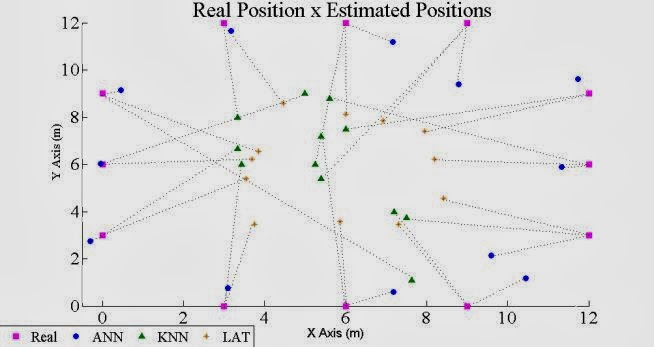
Performance Evaluation of Lateration, KNN and Artificial Neural Networks Techniques Applied to Real Indoor Localization in WSN


Leomário Machado, Mauro Larrat and Dionne Monteiro
Research Group on Computer Networks and Multimedia Communication
Federal University of Para – UFPA
Belém/PA - Brazil

Abstract-In Wireless Sensor Networks, several protocols and algorithms seek to prolong the network lifetime; among them, the localization algorithms are used as an accessory to provide the smallest distances for sending messages. This paper compares the Lateration, KNN and ANN as localization techniques to estimate planar coordinates using the RSSI in an indoor environment using a real WSN based on IRIS motes. The results show that a well worked out ANN is superior to Lateration and KNN.


Our application of ANN used for the localization of nodes in WSN is accomplished through the acquisition of RSSI from the messages sent from each node. Subsequently, these data are used to train and validate the network. For each location point, the mean and standard deviation are calculated to identify the 10% worst samples. With this, only accurate samples are used to train the ANN. To train the ANN, the collected points (x, y) are normalized maintaining those data output values between 0 and 1. To define the architecture of the ANN, several tests are done to achieve a satisfactory configuration of the ANN, i.e., number of hidden layers, number of neurons in each layer, activation function for each layer or neuron and training algorithm.