Yapay Sinir Ağları Nedir

Yapay Sinir Ağları Hakkında özet bilgiler

Fann Nedir

Fast Artifical Neural Networks Kütüphanesi hakkında

FannTool

Nedir Ne işe yarar Nasıl Kullanırız

What are Artificial Neural Networks ?

short info about Artificial Neural Networks

What is FANN ?

about Fast Artifical Neural Networks library

FannTool

What is and How to use

Makale etiketine sahip kayıtlar gösteriliyor. Tüm kayıtları göster

1 Aralık 2013 Pazar

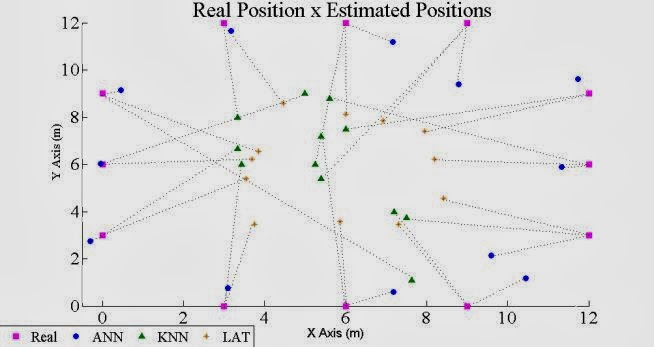
Performance Evaluation of Lateration, KNN and Artificial Neural Networks Techniques Applied to Real Indoor Localization in WSN


Leomário Machado, Mauro Larrat and Dionne Monteiro
Research Group on Computer Networks and Multimedia Communication
Federal University of Para – UFPA
Belém/PA - Brazil

Abstract-In Wireless Sensor Networks, several protocols and algorithms seek to prolong the network lifetime; among them, the localization algorithms are used as an accessory to provide the smallest distances for sending messages. This paper compares the Lateration, KNN and ANN as localization techniques to estimate planar coordinates using the RSSI in an indoor environment using a real WSN based on IRIS motes. The results show that a well worked out ANN is superior to Lateration and KNN.


Our application of ANN used for the localization of nodes in WSN is accomplished through the acquisition of RSSI from the messages sent from each node. Subsequently, these data are used to train and validate the network. For each location point, the mean and standard deviation are calculated to identify the 10% worst samples. With this, only accurate samples are used to train the ANN. To train the ANN, the collected points (x, y) are normalized maintaining those data output values between 0 and 1. To define the architecture of the ANN, several tests are done to achieve a satisfactory configuration of the ANN, i.e., number of hidden layers, number of neurons in each layer, activation function for each layer or neuron and training algorithm.

21 Eylül 2013 Cumartesi

Novel Patterns and Methods for Zooming Camera Calibration

Novel Patterns and Methods for Zooming Camera Calibration
Andrea Pennisi, Domenico Bloisi, Claudio Gaz, Luca Iocchi, Daniele Nardi
Department of Computer, Control, and Management Engineering
Sapienza University of Rome
via Ariosto 25
00185, Rome, Italy
In Journal of WSCG, volume 21, 2013.

Camera calibration is a necessary step in order to develop applications that need to establish a relationship between image pixels and real world points. The goal of camera calibration is to estimate the extrinsic and intrinsic camera parameters. Usually, for non-zooming cameras, the calibration is carried out by using a grid pattern of known dimensions (e.g., a chessboard). However, for cameras with zoom functions, the use of a grid pattern only is not sufficient, because the calibration has to be effective at multiple zoom levels and some features (e.g., corners) could not be detectable. In this paper, a calibration method based on two novel calibration patterns, specifically designed for zooming cameras, is presented. The first pattern, called in-lab pattern, is designed for intrinsic parameter recovery, while the second one, called on-field pattern, is conceived for extrinsic parameter estimation. As an application example, on-line virtual advertising in sport events, where the objective is to insert virtual advertising images into live or pre-recorded television shows, is considered. A quantitative experimental evaluation shows an increase of performance with respect to the use of standard calibration routines considering both re-projection accuracy and calibration time.

...
The second video, that contains the “+” sign captured at different zoom levels, is used to refine the calibration
parameters, in particular, the principal point (u;v) and the focal lengths fx and fy, and the radial distortion
coefficients k1 and k2 are considered. For regularizing these parameters an Artificial Neural Network (ANN) based approach [FANN Fast Artificial Neural Networks ] is used. Two different ANNs have been implemented, the former for managing the lower zoom levels, the latter for the higher ones.

28 Ağustos 2013 Çarşamba

Prediction of the energy values of feedstuffs for broilers using meta-analysis and neural networks


Prediction of the energy values of feedstuffs for broilers using meta-analysis and neural networks
F. C. M. Q. Mariano,C. A. Paixão,R. R. Lima,R. R. Alvarenga,P. B. Rodrigues and G. A. J. Nascimento (2013).
animal, Volume 7, Issue09, September 2013 pp 1440-1445
http://journals.cambridge.org/action/displayAbstract?aid=8962130


Abstract

Several researchers have developed prediction equations to estimate the metabolisable energy (ME) of energetic and protein concentrate feedstuffs used in diets for broilers. The ME is estimated by considering CP, ether extract, ash and fibre contents. However, the results obtained using traditional regression analysis methods have been inconsistent and new techniques can be used to obtain better estimate of the feedstuffs’ energy value. The objective of this paper was to implement a multilayer perceptron network to estimate the nitrogen-corrected metabolisable energy (AMEn) values of the energetic and protein concentrate feeds, generally used by the poultry feed industry. The concentrate feeds were from plant origin. The dataset contains 568 experimental results, all from Brazil. This dataset was separated into two parts: one part with 454 data, which was used to train, and the other one with 114 data, which was used to evaluate the accuracy of each implemented network. The accuracy of the models was evaluated on the basis of their values of mean squared error, R 2, mean absolute deviation, mean absolute percentage error and bias. The 7-5-3-1 model presented the highest accuracy of prediction. It was developed an Excel® AMEn calculator by using the best model, which provides a rapid and efficient way to predict the AMEn values of concentrate feedstuffs for broilers.

FannTool;

 The software FANN TOOL 1.2 (http://code.google.com/p/fanntool/) was used to implement the networks.


2 Mart 2013 Cumartesi

Yapay Sinir Ağları ile Epilepsi İçin Otomatik EEG analizi


Özet :

Bu çalışma Epileptik ve Normal EEG verilerinin , Yapay Sinir Ağları ile ve PoincarePlot2D metoduyla çıkarılan öznitelikleri kullanarak sınıflandırılması üzerinedir.

Giriş :


Epilepsi Dünya nufusunun %1'ni etkileyen bir rahatsızlıktır. Beynimiz milyarlarca sinir hücresinden oluşur ve bu hücreler üzerinde sürkeli bir elektiriksel iletişim vardır. Epilepside Beynin normalde çalışması ile ilgili elektriğin, aşırı ve kontrolsüz yayılımı sonucu oluşan ve herhangi bir uyarı olmaksızın tekrarlayan, çoğunlukla geçici bilinç kaybına neden olan bir hastalıktır.

EEG yani Elektroensefalografi beynin elektriksel aktivitesini ölçmek için kullanılan bir metoddur. Aynı zamanda epilepsili hastaları ve şüphe oluşturan nöbet bozuklukları olan hastaları incelemekte kullanılan önemli bir tetkiktir.

Uzun süreli EEG sinyallerinin incelenmesi ve istenen bilgilerin çıkarılması oldukça uzun zaman alan ve tecrübe gerektiren bir iştir. Bu yüzden  Otomatik EEG analiz sistemleri üzerinde çalışmalar yapılmaktadır. Bu çalışmada benzeri bir sistem üzerinedir.

Metod :

Pek çok Yapay Zeka uygulamasında olduğu gibi ilk aşamalardan biri Öznitelik Çıkarma işlemidir. Biz bu çalışmada PoicarePlot2D diye adlandırdığımız -deneysel- bir metodu uyguladık.

Poicare Plot  adını fransız matematikçi H. Poincare den alan bir metoddur.  Basitçe anlatırsak
X1, X2,... Xn 
şeklindeki bir zaman serisinin  2 boyutlu bir koordinat sisteminde  sırayla

 (X1, X2 ) ,   (X2, X3 ) ,  (X3, X4) , .... ,   (Xn-1, Xn )

noktalarının  çizilmesidir.

 Mesela Basit bir sinus serisinin

Poincare Grafiğine dönüşmüş hali

 Şeklinde görünür.

Öznitelik çıkarma işleminde veri seti ile Poincare Grafiği oluşturulur ve çıkan şeklinden yola çıkılarak 20x20 lik bir matris oluşturulur.


Sinus verisi için çıkarılan öznitelik matrisi bu şekildedir.

İkinci aşama ise çıkarılan özniteliklerin seçilecek bir Yapay zeka Algoritmasıyla sınıflandırılmasından ibarettir. Biz çalışmamızda Yapay Sinir Ağı metodunu kullandık. YSA için FANN kütüphanesini kullandık .  Eğitimi ve sonuçların testi içinde FannTool programından faydalandık.

Veri Seti :


Çalışmamızda kullandığımız ,  Bonn Üniversitesinde,  Epileptoloji Bölümünün hazırladığı  bir EEG veri setidir.  Verilere  bu adresden ulaşabilirsiniz. 
Bütün kayıtların alımı 128 kanallı kayıt sisteminde 12-bit A/D dönüstürücü ile yapılmıştır. Örnekleme frekansı 173.61 Hz dir. Band-geçiren filtre aralıgı ise 0.53–40 Hz (12 dB/octave) dir.
5 sınıfa ayrılmış veriler var ve her sınıfda 100 adet veri dosyası var her dosyada 4096 değer var.

  • Sınıf A  : Sağlıklı Gönüllülerden alınmış Göz Açık ( Z )
  • Sınıf B  : Sağlıklı Gönüllülerden alınmış Göz Kapalı ( O )
  • Sınıf C  :  Epilepsi hastası Kriz dışında Epileptik olmayan bölgeden  ( N )
  • Sınıf D  : Epilepsi hastası Kriz dışında Epileptik olan bölgeden  ( F )
  • Sınıf E  : Epilepsi hastası Kriz esnasında  ( S )

Uygulama :


Öncelikle  Veri setimizden

PoincarePlot2D metoduyla

Öznitelik çıkarma işlemini gerçekleştiriyoruz.


Bütün Sınıflandırma işlemini tek YSA ile yapmaya kalkıştığımızda Yaptığımız çeşitli denemeler sonucunda Test için ulaşabildiğimiz en yüksek başarı % 70 lerin biraz üstünde oluyor.

Bu yüzden bizde sınıflandırma işlemini parçalara ayırıyoruz ve her parça için ayrı YSA eğitiyoruz.
Bütün sınıflandırmayı 3 YSA ile gerçekleştiriyoruz

Birinci YSA ;  EEG verisi Sağlıklı birinden mi Epilepsi hastasından mı alınmış  kararını veriyor
500 veriden  375'ini eğitim ve 125'inide test için kullanıyoruz.

400 giriş 1 Çıkış

İkinci YSA ;  İlk YSA sonucunda Epilepsi Hastasından alınmış bir EEG ise, Verinin alınma konum ve yerine karar veriliyor.
  • Kriz sırasında, 
  • Kriz dışında, Epileptik taraftan 
  • Kriz dışında, Epileptik olmayan taraftan 

Kriz dışında 3 durum var. 300 veriden  225'ini eğitim ve 75'inide test için kullanıyoruz.


400 giriş 3 Çıkış

Üçüncü YSA ;  İlk YSA sonucunda Sağlıklı bireylerden alınmış bir EEG ise Göz Kapalımı, Açıkmı  kararını veriyor.  200 veriden  150'ini eğitim ve 50'inide test için kullanıyoruz.
 400 giriş 1 Çıkış  


Sonuç :

YSA ile yaptığımız bütün sınıflandırmalarda  ulaştığımız sonuç;
hem Eğitim hemde Test verileri için %100 başarı
Aynı veri seti kullanılarak yapılan  diğer çalışmaların başarıları aşağıdaki tabloda görülmektedir.


Yapılmış olan benzeri çalışmalar hakkındaki detaylı bilgiye
Automated Epileptic Seizure Detection Methods: A Review Study 
çalışmasından ulaşabilirsiniz yukardaki tabloda o çalışmadan alınmıştır.

30 Ekim 2012 Salı

Forecasting the ozone concentrations


Forecasting the ozone concentrations with WRF and artificial neural network based system

Department of Climatology and Atmosphere Protection
Wrocław University, Poland

Introduction;

Ground level ozone (O3 ) has serious adverse impacts on human health and ecosystems. Accurate tools that support human and ecosystem protection are necessary. The most often used are complex atmospheric chemistry models (Vieno et al. 2010), driven by off-line meteorology or integrated on-line to allow for two directional effects of atmospheric chemistry and meteorology. These tools need a significant amount of computational effort, but are able to provide information on spatial and
temporal information on atmospheric ozone concentrations. Statistical methods, including regression models and artificial neural networks (ANN) are also often applied to provide information on spatial (Pfeiffer et al. 2009) and temporal variability of O . ANN were also found to be useful for O 3 3
forecasting, and were applied to e.g. metropolitan areas by local environmental or health agencies (Comrie 1997, Corani 2005, Ibarra-Berastegi et al. 2008, Yi and Prybutok 1996). In this paper we present the preliminary results of the O3 forecasting system for the city of Wrocław, SW Poland. Two main tools are used to estimate the hourly O3 for the next 3 and 24 hours – the Weather Research and Forecasting (WRF) mesoscale meteorological model and an artificial neural network (ANN). WRF provides the meteorological variables for the next 3 and 24 hours, and the ANN is then applied to forecast the O3 concentrations.

FannTool ;


...
 The analysis was performed with
the Fast Artificial Neural Network library and FANN Tool 1.1 interface.
...


8 Ekim 2012 Pazartesi

Intelligent Condition Monitoring Systems for an AUV Robot


Intelligent Condition Monitoring Systems for an AUV Robot    

Journal : Applied Mechanics and Materials (Volumes 152 - 154)
Volume     : Mechanical Engineering and Materials
Authors : Amir Parsa Anvar, Manjit S. Garcha, Ritchie D. Saliba, Taranjit M. Singh, Amir M. Anvar, Steven Grainger

January, 2012

Abstract:

This paper discuses intelligent techniques used to monitor and correct operational abnormalities in Autonomous Underwater Vehicles. Neural Networks are usually utilised in the diagnosis section, while Fuzzy Logic is implemented in the prognosis and remedy sections. The performance of an AUV’s sub-system has a great affect on the overall success of the vehicle. Once a sub-system becomes faulty, the various components associated with the control of the AUV may get influenced, which can degrade the overall performance of the integrated system or make it invalid altogether . Such failures may result in large amounts of wasted time, loss of data and increases in mission costs.

FannTool ;

...
These input values were fed into the Fast Artificial Neural Network
(FANN) toolbox, FannTool-1.1, to provide simulations of a Neural Network for the inputand output across each sensor.
...

6 Ekim 2012 Cumartesi

Yapay Sinir Agları Yöntemi le Kalıp slerinde Bir Adam-Saat Tahmini Modeli


SÖNMEZ, M., DİKMEN, S.Ü., (2009),
“Yapay Sinir Ağları Yöntemi İle Kalıp İşlerinde Bir Adam-Saat Tahmini Modeli”,
İMO, 5. Yapı İşletmesi / Yapım Yönetimi Kongresi, 22-23 Ekim 2009, Eskişehir.

Özet:

Yapay sinir ağları, temelinde insan beyninin çalışma ilkelerini taklit ederek çalışan problem
çözümleme yöntemidir. Yöntemin en önemli özelliği gerçek veriler ile kurulan modelin
eğitilmesi ve eğitilmiş olan modelin yeni veriler için sonuç üretebilmesidir. Model sürekli
öğrenerek kendini geliştirebilmektedir. Bu çalışmada, bina türü projelerde kaba yapı
maliyetleri içerisinde önemli yer tutan kalıp işlerine ait adam-saat ve verimlilik değerlerinin
sağlıklı tahmini amacıyla bir karar destek sistemi oluşturulması hedeflenmiştir. Çalışmanın
ilk aşamasında bir yapay sinir ağı oluşturulmuştur. İkinci aşamada oluşturulan bu ağ elde
mevcut bulunan üstyapı projelerine ait kalıp puantajları eğitilmiştir. Son aşamada ise model
farklı projelerden elde edilen veriler ile test edilmiştir.

An Artificial Neural Networks Model for the Estimation of Formwork Labour


Journal of Civil Engineering and Management
Volume 17, Issue 3, 2011

An Artificial Neural Networks Model for the Estimation of Formwork Labour
S. Umit Dikmen  & Murat Sonmez


Abstract:

 Artificial Neural Networks (ANN) is a problem solving technique imitating the basic working principles of the human brain The formwork labour cost constitutes an important part within the costs of the reinforced concrete frame buildings. This study suggests a method based on artificial neural networks developed for estimating the required manhours for the formwork activity of such buildings. The introduced method has been verified in the study with reference to
the test conducted involving two case studies. In all cases, the model produced results reasonably close to actual field measurements. The model is a simple and quick tool for the estimators and planners to aid them in their work.

FannTool;

...For the training, testing and running the ANN model proposed, software named FANN Tool is selected. FANN Tool is part of a free open source neural network library named “The Fast Artificial Neural Network Library – FANN” (FANN 2010). It is the graphical user interface (GUI) to the FANN library which allows its easy usage without the need of programming. This tool enables the users to prepare the data in FANN library standard, and design, train, test and run the artificial neural network model. The reasons of  selection of this software are simply its ease of use and its free availability. Thus even the
small construction companies with limited information technologies (IT) capabilities can download and start using immediately
...

ANN for Gesture Recognition using Accelerometer Data

Procedia Technology 3 ( 2012 ) 109 – 120
The 2012 Iberoamerican Conference on Electronics Engineering and Computer Science

ANN for Gesture Recognition using Accelerometer Data
Blanca Miriam Lee-Cosio, Carlos Delgado-Mata, Jesus Ibanez

Abstract


This paper presents the application of Artificial Neural Networks to recognise among gestures trajectory patterns in a Euclidean space. The data was filtered and normalised by the Fast Fourier Transform. The k-means algorithm was used to parametrise the optimized data as input of the ANN by creating 15 clusters of data. Using the FANN tool , the ANN was modeled trained and tested so that the output of the ANN is the recognised gesture . The raw data comes from a set of 8 trajectories representing gestures captured by a device based on accelerometers like the Nintendo Wii remote.

Comparison Of Multivariate and Pre-Processing Methods for Quantitative Laser-Induced Breakdown Spectroscopy of Geologic Samples


Comparison Of Multivariate and Pre-Processing Methods for Quantitative Laser-Induced Breakdown Spectroscopy of Geologic Samples

R. B. Anderson1, R.V. Morris,S.M. Clegg, J.F. Bell III,S. D. Humphries, R. C. Wiens,

Introduction: 

The ChemCam instrument selected for the Curiosity rover is capable of remote laser-induced breakdown spectroscopy (LIBS). We used a remote LIBS instrument similar to ChemCam to analyze 197 geologic slab samples and 32 pressed-powder geostandards. The slab samples are well-characterized and have been used to validate the calibration of previous instruments on Mars missions, including CRISM , OMEGA , the MER Pancam , Mini-TES , and Mössbauer  instruments and the Phoenix SSI . The resulting dataset was used to compare multivariate methods for quantitative LIBS and to determine the effect of grain size on calculations. Three multivariate methods - partial least squares (PLS), multilayer perceptron artificial neural networks (MLP ANNs) and cascade correlation (CC) ANNs - were used to generate models and extract the quantitative composition of unknown samples. PLS can be used to predict one element (PLS1) or multiple elements (PLS2) at a time, as can the neural network methods. Although MLP and CC ANNs were successful in some cases, PLS generally produced the most accurate and precise results.

FannTool;

...
CC ANNs, an alternative type of neural network that determine their own structure as they are trained, were also tested, using the FannTool graphical interface to the open-source Fast Artificial Neural Network (FANN) library    ...

Control of a Thermoelectric Brain Cooler by Adaptive Neuro-Fuzzy Inference System


Instrumentation Science & Technology
Volume 36, Issue 6, 2008

Control of a Thermoelectric Brain Cooler by Adaptive Neuro-Fuzzy Inference System
R. Ahiska , A. H. Yavuz , M. Kaymaz  & İ. Güler

Abstract:

In this study, neuro-fuzzy control of a thermoelectric head cooler
system (thermoelectric helmet) is developed for brain hypothermia applications.
Hypothermia is a medical treatment method of protecting the brain, in which
the temperature of the brain drops below the critical level for reducing oxygen
consumption of tissues. The brain should be kept at a certain temperature by a
suitable control for hypothermia applications. The temperature of the thermoelectric
head cooler system changes according to the current intensity supplied.
The control of the thermoelectric head cooler system was performed according
to the initial membership functions, which was determined by an expert using
fuzzy logic control. The system was modeled by an adaptive neuro-fuzzy inference
system (ANFIS). The data were then entered into the system and new membership
functions were determined. By this way, learning ability of the artificial
neural network and the abilities of fuzzy logic, such as decision making, were
combined and a more effective solution was developed. The system software
can be reprogrammed with the new membership functions.

FannTool :

...
The data files obtained are shown in Table 4. An ANN model
(4 >2 >1) was projected with Fast Artificial Neural Network Tool
(FannTool version 0.60) by using this data file and has been trained. An
ANN trained was recorded and an interface unit was projected by using
C programming language (Figure 6).

...